Namma Suspension
Super Shock Absorbers
w/ Intelligence
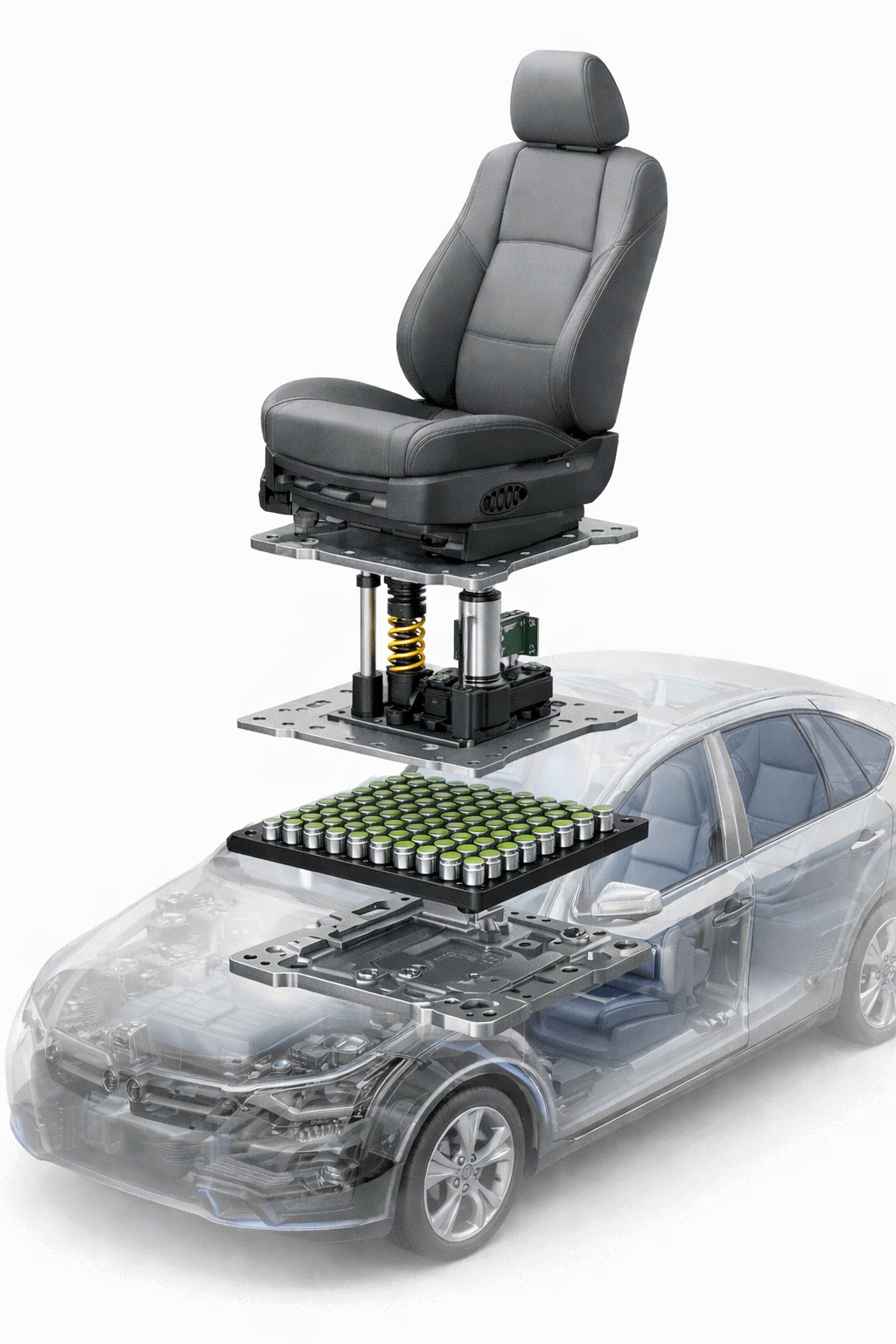
Pre-computable road profiles. Our vehicles repeat routes. Connected fleet vehicles map road surfaces. We can pre-compute suspension commands — where others predict in 10ms real-time, we work with low-cost electronics because we already have the map.
Software-first leverage. Principles from building reliable, performant software systems apply directly to active suspension control. There is significant room to out-innovate incumbents on the software and simulation side.
First-principles 80/20s. The right physics insights and basic modelling may reveal untapped opportunities. We've taken contrarian, simple approaches in software systems by questioning fundamentals — the same method applies to mechanical design.
Large motion
1–30 Hz · ±50mm · primary ride control
Fine vibration
15–100+ Hz · ±5–10mm · localized cancellation
Passive
20–200+ Hz · passive · no power · fail-safe
| Mechanism | Latency | Bandwidth | Force | Status |
|---|---|---|---|---|
| Ball screw | 2.4 ms | ~30 Hz | High | COTS — interim Layer 1 |
| Linear motor | 0.8 ms | ~100 Hz | Med-High | Target — in-house build |
| Hydraulic | 8 ms | ~15 Hz | Very high | Deprioritized |
| VCA (single) | <0.5 ms | 100+ Hz | Low (5–50N) | Layer 2 — in-house |
| VCA (swarm ×20) | <0.5 ms | 100+ Hz | Med (600–1kN) | Layer 2 — experimental |
Building a linear motor in-house
Design from first principles: permanent magnet track geometry, coil optimization (fill factor, thermal limits, back-EMF shaping), Halbach arrays for field shaping, air gap tolerance. 2D iteration in FEMM, 3D validation with Elmer FEM (magnetostatics, transient magnetics, coupled thermal). Extract force surface F(position, current) as a surrogate model bridging FEM to real-time control. Target: ±50mm, 100Hz, 500N+.
Four-layer simulation pipeline
Layer 1: Electromagnetic FEM — flux density, force curves, saturation, eddy currents. Layer 2: Surrogate extraction — F(x,i) lookup via curve fitting, bridging FEM to real-time. Layer 3: System dynamics in Julia/ModelingToolkit — embed force surface with mechanical dynamics, control laws, symbolic→auto-Jacobian→fast ODE. Layer 4: RL on GPU — NVIDIA Warp for differentiable physics, MuJoCo for rigid body, JAX for end-to-end gradients.
Making the motor do 10% of the work
The cost breakthrough: springs handle static load, opposing magnets (Halbach array) provide zero-power negative stiffness — pre-loading the system so the motor only fights dynamic forces. The spring + magnet negative stiffness system has closed-form dynamics. Simulate and tune this first — the passive layer determines the active motor's force budget and therefore its size, cost, and thermal envelope.
Multi-layer coordinated control
Three actuation layers at different bandwidths and stroke limits need unified real-time coordination. Force allocation across layers, skyhook + feedforward preview + RL-based adaptive tuning. Key advantage: our vehicles repeat routes, connected fleet builds the road map, we pre-compute where others predict in real-time.
Non-obvious control policies
Classical control (PID, LQR, H∞) gives a baseline. Nonlinear magnetic springs, stroke saturation, non-stationary inputs may admit better policies. RL in MuJoCo/Warp, sim-to-real transfer. Reward: ISO 2631-weighted RMS acceleration. If the pipeline is end-to-end differentiable (JAX), gradient-based policy search becomes possible over a large non-convex space.
Indian road surface characterization
No standard dataset captures Indian road severity. Instrument vehicles, drive representative routes, build stochastic road models (PSD-based + transient overlays). Connected fleet vehicles build this dataset over time. Without good road data, we're optimizing for the wrong problem.
Test rig + first physical prototype
Seat mount, road-input simulator (shaker table / eccentric cam), swappable actuator modules, full sensor suite. Commission coil winding, buy NdFeB magnets and linear guide rails, close the loop with a servo drive on a force sensor. Measure F vs. current and compare to FEM. Ground-truth the models with physical data early.
Voice coil actuator swarm
Standard VCAs: ±10–20mm stroke. Longer stroke means the coil exits uniform field — force drops nonlinearly. Investigating moving-magnet topology, Halbach arrays, multi-stage stacking. Building VCAs is straightforward — the question is useful stroke range vs. pairing with Layer 1 for large displacements.
10× simulation and AI-driven design
Simulate before fabricating. Elmer FEM for electromagnetics, Julia/ModelingToolkit for system dynamics, MuJoCo + NVIDIA Warp for RL policy training. Full pipeline: FEM → surrogate model → ODE dynamics → GPU-native RL. All open-source, all GPU-capable. Every physical prototype preceded by hundreds of virtual ones.
Creative hardware prototyping
Desktop test rigs before vehicle installs. Commission coil winding, close the loop with a servo drive and force sensor early. Instrumented testing with data feedback into simulation. Build small, measure everything, iterate in days not months.
Layer existing tech, invent what's missing
Linear motors, VCAs, magnetic springs, eddy-current dampers, air springs — all exist individually. Innovation: the layered architecture where passive elements carry 90% of the load. Where COTS fails, build in-house. Modular: features toggle for cost — luxury seat to public transit.
Convert hardware → software problems
Active suspension = control on sensors + compute. Moore's law, better MEMS, RL advances — all compound over time. Connected fleet builds road maps that enable pre-computation with low-cost electronics. Push mechanical complexity into software where exponential trends work in our favor.
- Machining — lathe, mill, drill press
- Welding — TIG, MIG, stick (steel, aluminum)
- Motor winding, coil fabrication, magnet assembly
- Soldering, harness building, PCB rework
- Sensor integration — accelerometers, IMUs, encoders
- Test rig assembly and instrumentation
- Visiting shops, sourcing components, getting quotes
- Dynamics — Lagrangian mechanics, multi-body systems
- Control — PID, LQR, H∞, skyhook, adaptive
- Electromagnetics — Lorentz force, magnetic circuits, FEA
- RL / optimization — policy gradient, sim-to-real
- Signal processing — PSD, transfer functions, filtering
- Simulation — Julia, MuJoCo, Python scientific stack
- First-principles physics modelling and intuition
"Use inventive technology and AI to do larger good for the public — build transportation so comfortable and affordable that a commuter can work undisturbed on the worst road surface in the world."